Showing posts with label ghosts. Show all posts

Ghostly Oxford

Who doesn't love a good ghost story? And ghost stories abound in the city of dreaming spires. Now, I've never seen a ghost, but I know people (very intelligent and well-adjusted people) who swear that they have. So I'm willing to keep an open mind.
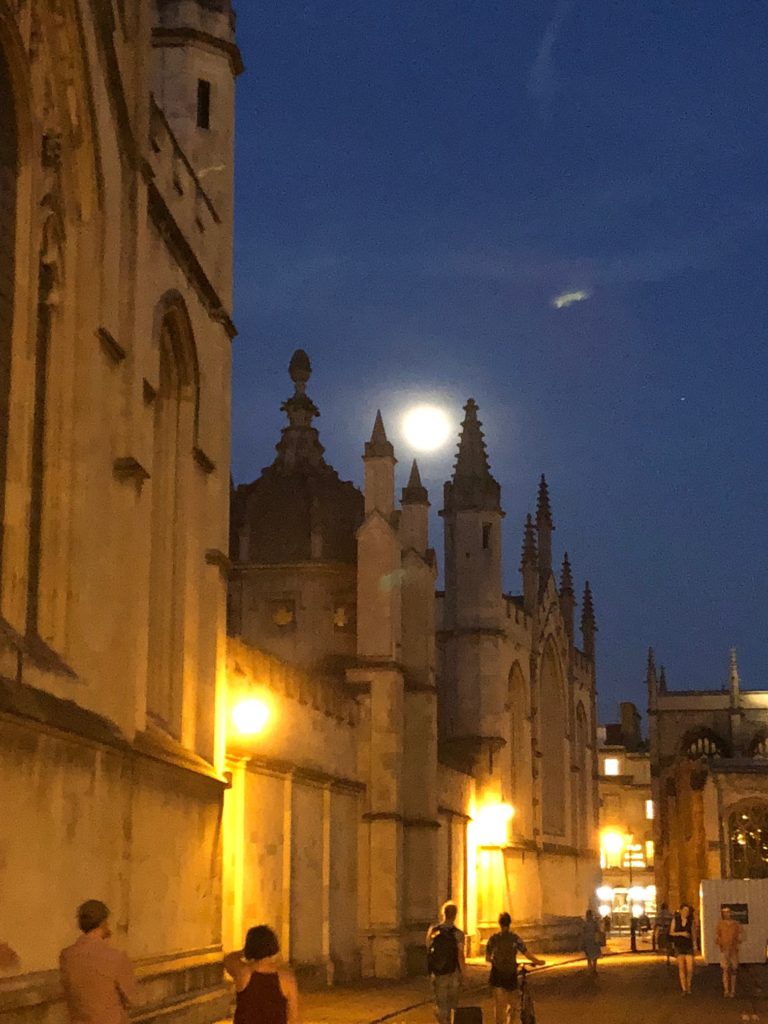

I'm not surprised that there are many supernatural sightings in Oxford. The city is amazingly romantic at night, when the day trippers have left and it is the haunt of students, Oxonians, the homeless . . . and hoards of teenaged foreign language students.


Merton College

Lovely Merton College library (below) has the ghost of poor Colonel Francis Windebank, a Royalist who was executed by his own side in 1645, during the English Civil War.


It’s a sad story. Windebank was a young, newly married colonel in the Royalist army  and was appointed governor of Bletchingdon Park, near Oxford (below).  

In April 1645 he invited his young wife and friends for a ball at the house to raise their spirits (not the ghostly kind).  But a Parliamentarian spy may have been present, as during the ball the house came under attack by Cromwell’s forces. 

The house was well protected, and probably could have withstood the attack, but Windebank surrendered immediately. It is likely that he did so in order to protect the lives of his wife and friends.
Windebank went to explain to the King in Oxford (where the King had his headquarters), but his excuses were not accepted and he was tried by a Royalist court-martial for failing to protect Bletchingdon Park.

They took just three hours to find him guilty and sentence him to death by firing squad.

His execution took place against the length of town wall abutting Merton College. Windebank bared his chest to the muskets and exclaimed “God Save the King.”

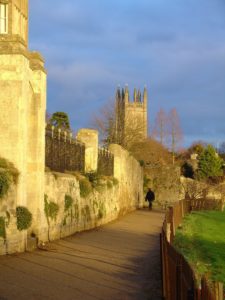
Windebank’s ghost haunts the site of his execution at Dead Man’s Walk, (above) which abuts Merton College, and has also been seen in the college library.

He’s a well known Oxford ghost, and is thought to haunt because of his lingering feeling of injustice at being executed for what he considered a chivalrous action.

It is also said that Colonel Windebank walks around on his knees. Rational thinkers (?) say that it is more likely that he is walking on the original (lower) ground level of the seventeenth century.
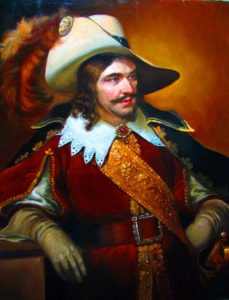

I couldn’t find a picture of poor Francis, but here’s a generic Royalist Cavalier, so if you’re wandering along Dead Man’s Walk, you’ll know what to look for.


Wadham College

In my husband's family Wadham is known as Wadham-Oh. His uncle was a student there in the '50s and when someone asked him what college he was a member of and he said "Wadham", the inevitable reply was, "Oh."

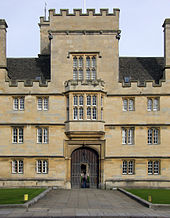
And yet Wadham is not a new college. It was founded in 1610 by Dorothy Wadham, in accordance with the terms of her late husband's will. She was the first woman not of the Royal family to found a college at Oxford.


The land she chose was originally the site of an Augustinian Priory. In those days its lovely gardens were a series of orchards and market gardens.
Perhaps this is why Wadham's well-known ghost is thought to be a priest. A white figure in robes walks from the chapel door (in the left-hand corner in this photo) across first quad and into the hall (in the right-hand corner, out of sight), and then across the hall to vanish just in front of High Table (below).
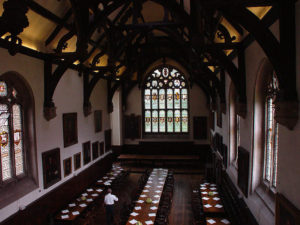
The ghost has been observed over the years by witnesses of veracity, including one head porter and two scouts. And the former Head-Steward, Mr Maurice Howes, would complain on a regular basis of hearing footsteps late at night from his office. They seemed to enter the hall, but never left it...
Augustinian Friar

  
I go to the College every year to see Shakespeare performed in the gardens. This year it was a lively production of Love's Labours Lost. In the interval I went from the garden, past the chapel door and into the first quad to visit the amenities, but I didn't see the resident ghost. 


New College Lane/Queen’s Lane


One of my favourite places at night in Oxford (and during the day) is the atmospheric New College Lane, which becomes Queen’s Lane once past New College. Down this winding lane the cavaliers rode on their way to do battle with Cromwell’s New Model Army.


Sometimes, they say, particularly on a windy autumn evening, you can hear the ghostly hoofbeats… 

And this is what was heard by an Australian tourist, as reported by the Oxford Mail in 2010:
http://www.oxfordmail.co.uk/news/8427740.Tourist_captures_spooky_image_on_camera/


Another tourist captured a ghostly image in that very lane (left). 

I have to admit to feeling a real sense of spookiness if I walk down that lane alone as dusk falls. The wind dances through the winding lane, picking up little sounds and magnifying them. It has a sense of timelessness that is compelling. 


St John’s College

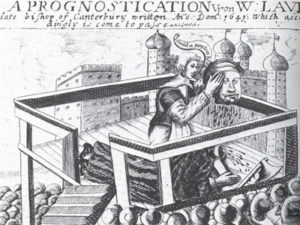
The distinguished College has a most distinguished ghost, Archbishop of Canterbury, William Laud, who was beheaded in 1645, after being impeached by the Long Parliament.

(The Long Parliament lasted from 1640 until 1660, and passed, among other acts, the first Habeas Corpus Act – which as a lawyer gets me quite excited, because a Writ of Habeas Corpus provides that the Crown must “certify the true cause” of imprisonment. It’s one of the fundamentals of English and Australian criminal law).

Here’s a particularly horrible depiction of Laud's execution:


Laud was educated at St Johns, and his bones are buried under the altar of the chapel.

His ghost has been known to disrupt students in St John’s College Library.

Some say he pulls his head from his neck and rolls it at people, others say he kicks it along the floor with a candle in his hand. Here’s the library where he plays football with his head.
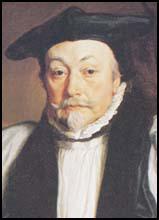


Now those who read Harry Potter will recognise the similarity to Nearly Headless Nick. But Laud looks nothing like John Cleese. In fact, I don’t think the Archbishop looks like the ghostly sort, myself. I certainly don’t see him playing football with his head. (I’ve always seen him as an honourable man, on the wrong side of history.)


University College

The wonderfully named Obediah Walker (the ghost who walks – get it!) was the Catholic Master of University College in the seventeenth century.


He tried to follow James I into exile in France but was captured and imprisoned for ten years. When released he was a broken man and his ghost supposedly haunts Staircase VIII (where the Master’s residence used to be).
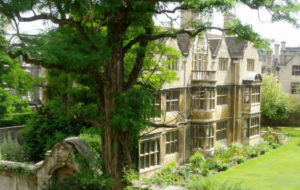


I could find no picture of Obediah, but here is Staircase VIII,
the place where Walker walks.


Christ Church College
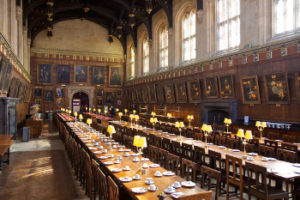

Oxford was a Royalist stronghold during the English Civil War. The King made the Christ Church College Deanery (below) his palace and held Parliament in its Great Hall (right).


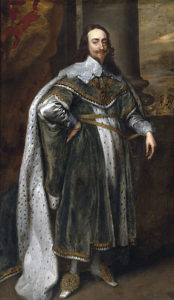
The spirit of King Charles I has been known to appear in the grounds of Christ Church College and in the Great Hall, sometimes with his head, sometimes without.


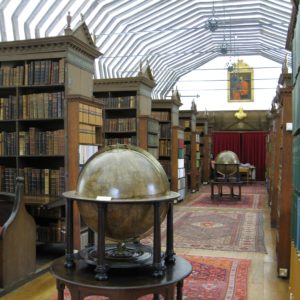
Apparently King Charles also appears in the Bodleian Library. While in Oxford, the King was denied leave to take books from the Bodleian in 1645. He has been seen at night running around in the upper reading room pulling books from the shelves reading one line and placing them back in an endless game of fortune telling, again sometimes with and sometimes without his head.
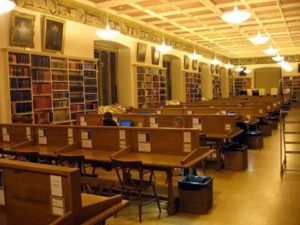


But that is not why I eschew the Upper Reading Room (above) and always do my study in the Lower Reading Room. I'd be quite chuffed to see a Royal ghost, actually...


Magpie Lane


In the former bank that stands on the corner of Magpie Lane is now the Quad restaurant, and I had a lovely brunch there last Thursday.
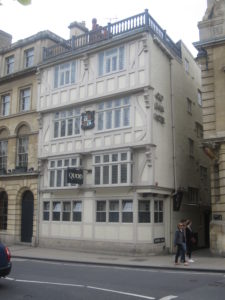

Next door is the entrance to delightful Magpie Lane.
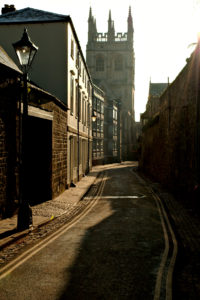
The lane leads to Merton Street and is reputedly haunted by the ghost of Prudence Bostock who died of a broken heart when her Cavalier lover ran away. She continues to roam the lane in the hope that he will return.

I've walked down this pretty little lane many times, and never has Dear Prudence come out to play (you have to be a Beatles fan to get that reference!!)


An Eighteenth Century Spectre - by Katherine Langrish


Thomas, Second Baron Lyttelton
“Sir,” said Dr Johnson to his friend Dr Adams, “it is the most extraordinary thing that has happened in my day.” 
 
He was speaking of the mysterious circumstances attending the death of Thomas, Second Baron Lyttelton, known in true Georgette Heyer fashion as ‘the wicked Lord Lyttelton’, born 30 January 1744, and died - as we shall see - on the night of the 27th November 1779.
 
Lyttelton was educated at Eton and Oxford, a charming and talented boy; too charming and talented for his own good, perhaps, for he became a notorious rake.  He fought duels, and ‘excelled the ordinary model of young debauchery everywhere’. He married to pay his gambling debts and then ran off to Paris with a barmaid; he entered the House of Commons in 1768 as MP for Bewdley, but was unseated for bribery the following year; he disappeared again to the Continent; but when his father died in 1774 he returned and took his seat in the Lords where, to secure his support, ministers bought him over with a lucrative sinecure – something which would pay him money and for which he would have to do little or no work – the ancient post of Chief Justice of Eyre beyond the Trent. 
 
Four years later, however, on the 25th November 1779, (possibly disappointed by his failure to obtain another sinecure and become a Keeper of the Privy Seals) Lyttelton changed sides and denounced Government and Court in a vitriolic speech. Horace Walpole comments ‘Lyttelton … has turned against the Court.'  Regarding his existing sinecure, Lyttelton said, ‘Perhaps I may not keep it long.’
 
He was correct.  By midnight on November 27th, he was dead.
 
On the night before his speech – the night of Wednesday 24thNovember – Lyttelton saw a ghost which told him he would die within three days. Between the Wednesday and the Friday, he mentioned this to various friends and acquaintances: Rowan Hamilton, and one Captain Ascough, who told a lady, who told another lady named Mrs Thrale who wrote it down in her diary on Sunday 28th November, the morning after Lyttelton’s midnight death:
 
Yesterday a lady from Wales dropped in and said that she had been at Drury Lane on Friday night.  “How,” I asked, “were you entertained?” “Very strangely indeed!  Not with the play, though, but the discourse of a Captain Ascough, who averred that a friend of his, Lord Lyttelton, has SEEN A SPIRIT, who warned him that he will die in three days.  I have thought of nothing else since.”
 
Horace Walpole, writing to a friend on Monday November 29th, says:
 
Lord Lyttelton is dead suddenly.  …The story is given out, that he looked ill, AND HAD SAID HE SHOULD NOT LIVE THREE DAYS; that he had gone to his house in Epsom… with a caravan of nymphs; and on Saturday had retired before supper to take rhubarb; returned, supped heartily, went into the next room and died in an instant. 
 
Within a short time, however, Walpole has picked up on the gossip around town: Lyttleton had claimed to have seen a robin – or some other bird – which changed into a woman and delivered him a death warning.  By December 11th Walpole writes with dry humour to another friend that ghost stories are back in fashion!
 
Lord Lyttelton’s vision has revived the taste; though it seems a little odd that an APPARITION should despair of getting access to his lordship’s bed, in the shape of a young woman, without being forced to use the disguise of a robin red-breast.
 
The ‘nymphs’ to whom Walpole refers in his first letter were the three Misses Amphlett; residing with their ‘chaperon’ Mrs Flood at Lyttelton’s house in Hill Street, Berkeley Square.  A few months later, in February 1780, Lord Westcote, Lyttelton’s uncle, questioned them, and wrote:
 
On November 25th, at breakfast in Hill Street, Lord Lyttelton told the young ladies and their chaperon that he had had an extraordinary DREAM.
 
He seemed to be in a room which a bird flew into; the bird changed to a woman in white, who told him he should die in three days.
 
He ‘did not much regard it, because he could in some measure account for it; for that a few days before he had been with Mrs Dawson, when a robin red-breast flew into her room.’  On the morning of Saturday [the 27th] he told the same ladies that he was very well and believed he should ‘BILK THE GHOST’. On that day – Saturday – he …went to bed after eleven, ordered rolls for breakfast, and, in bed, ‘died without a groan’ as his servant was disengaging him from his waistcoat.
 
Myself, I'm particularly taken with the juxtaposition of the caravan of nymphs and the rhubarb, and with Walpole's crack about the spirit not really needing to disguise itself as a robin to get into Lyttelton's bed... There was no inquest. 

And there's a postscript: on the fatal night, 27th November 1779, Mr Miles Peter Andrews, a friend of Lyttelton’s who was staying at Dartford, was woken when his bed-curtains were pulled open and he was confronted by Lord Lyttelton ‘in his robe de chambre and nightcap’. Suspecting a practical joke, Andrews rang the bell for his servant, and on turning back found Lord Lyttelton gone.  The house and garden were searched in vain, and about four in the afternoon of the next day, a friend arrived with news of Lyttelton’s death. The event was recorded in the next number of the Scots Magazine,December 1779.
 
But let us return to Dr Johnson, with whom we began, speaking of the mysterious affair with his friend Dr Adams.  Johnson was famously afraid of death.  He continues, “I heard it with my own ears from his uncle Lord Westcote. I am so glad to have evidence of the spiritual world that I am willing to believe it.”
 
Dr Adams replies (doubtless alluding to the Scriptures), “You have evidence enough – good evidence, which needs no support.”
 
“I like to have more!” Dr Johnson growls.


Things that go bump in the night - by Lesley Downer

Assorted strange creatures by Katsushika Hokusai (1760-1849)
In the 19th century, a time of particular upheaval and uncertainty in Japan, people would spend a summer evening sitting around telling ghost stories, lit by candles and lanterns (a hundred was the canonical number). At the end of each story they’d extinguish one until at the end of the last (and most frightening) story the last candle would go out, plunging the room into utter darkness - at which moment everyone would hold their breath, hoping a real ghost might materialise.

This year, as you will all know, there have been terrible and unprecedented floods in the south west. But usually the dog days of summer are even hotter and more stifling in Japan than we have had this year in Britain. In the old days Japanese would take all the sliding wooden and paper doors out of their houses so that the house became a breezy pavilion. Those that live in traditional houses still do. People made a point of eating oily foods like grilled aubergine and grilled eel and drinking iced barley tea. Essential accessories included a fan and a parasol. Another essential was ghost stories to send shivers down your spine. To this day the kabuki theatre always shows ghost stories.

Maruyama Okyo paints a ghost by Tsukioka Yoshitoshi (1839-1892)

Tsukioka Yoshitoshi, a great master of the bizarre, made a woodblock print depicting a famous Kyoto artist called Maruyama Okyo. It was said that Okyo’s paintings were so true to life that bees tried to pollinate the flowers he painted. He once made the mistake of painting a ghost. To his horror it came to life, looming up from the block. 

Japanese ghosts are the spirits of people whose lives have been cut short while they still have unfinished business - people who’ve died violently, haven’t received proper funerary rites, or died while consumed by a desire for vengeance. Such spirits can’t pass on peacefully to join their ancestors in the afterlife. According to Buddhist teaching, the journey from the world of the living to the world of the dead takes 49 days, and while they are in this limbo they can revisit the land of the living to sort out unfinished issues. A lot of these are the ghosts of women who have been spurned or killed by their lovers or husbands. They are yurei, which means something like 'faint or dim spirit'. 

Lantern Ghost by Hokusai
At the kabuki theatre I once saw the great male performer of female roles, Tamasaburo Bando, playing the ghost of a woman who had been killed by her husband. Her skin was white, her eyes sunken and ghastly. She was wearing a long white gown and floating high up the wall and her floor length hair was dishevelled and tangled in great knots. Wailing, she started tearing it out by the handful as clumps piled up in a heap on the floor. It was one of the most frightening things I’ve ever seen.

Katsushika Hokusai, the great woodblock print artist, loved depicting Japanese ghosts. The most famous and frightening ghost story of all is Yotsuya Kaidan, the story of the beautiful innocent Oiwa, who is poisoned and horribly disfigured by a rival who wants to marry Oiwa’s lover, Iemon. Oiwa ends up killing herself and the lover goes off with the rival. But Oiwa returns to haunt her faithless lover, emerging from a lantern hairless and jawless and with one eye hanging out of her head, until Iemon finally goes mad.

But yurei are not always women. There are also men, like Kohada Koheiji, a kabuki actor who specialised in yurei roles and whose wife had an affair with one of his rivals. The rival took him out for a boat ride, pushed him into the water and drowned him. But Kohada rose from his watery grave and haunted his wife and her lover for the rest of their lives, suddenly appearing leaning over the top of their mosquito net and grinning down horribly at them at the most unexpected moments. Both these stories, by the way, are based on true events.
Kohada Koheiji by Hokusai

And if these haven’t cooled you down enough, I have a ghost story of my own to scare you with.

I spent 3 years living in the small city of Kamakura, exactly an hour from Tokyo by train. It’s a beautiful place, full of mossy old temples and vermilion painted shrines with a huge famous stone Buddha.

My western friends and I rented a haunted house there. Japanese refused to live in it, which made the rent very cheap. Japanese ghosts are localised; they torment their own family members or whoever’s done them harm but they don’t trouble people at random and they don’t bother foreigners. In fact foreigners are so radically different that even the most ferocious of Japanese ghosts would probably steer well clear.

My friends and I lived happily in this large, rambling, rather shabby old house. It was beautiful. It had a tea ceremony hut and a carp pond and a very overgrown garden.

Everything was fine until the third summer. That year my western friends by chance all went away at the same time leaving me alone in the house. I had Japanese friends over to stay.
The Great Buddha in Kamakura

‘Lucky you,’ I told them. ‘You can have a room each!’

‘No, thank you,’ they replied. ‘That would be too frightening.’

I’d almost forgotten that the house was supposed to be haunted. Instead they all slept together in one room with their futon mattresses side by side down the middle.

The night after they left was my first on my own in the house. I was lying in my futons on the tatami mats of my room when I heard a distinct banging coming from the other end of the house, at the far end of a long dark corridor.

I listened hard. It sounded like boxes being thrown around. There was no one else in the house. I was definitely all alone. It couldn’t be a human being making all that noise. It could only be an obake - a one-legged umbrella ghost - but I certainly wasn’t going to go and investigate. I pulled my covers over my head, screwed my eyes tight shut and hoped for the best.

Thereafter I stayed well clear of the end of the corridor.
[Scroll on down to see the obake!]


Lesley Downer’s latest novel, The Shogun’s Queen, is an epic tale with plenty of ghosts, set in nineteenth century Japan, and is out now in paperback. For more see www.lesleydowner.com.

Woodblock print images courtesy of Wikimedia Commons. Photo of the Great Buddha by me.

Obake (on the right). The critters on the left are kappa.