Showing posts with label historical novel research. Show all posts

Waking up in a French cave, by Gillian Polack


This morning I’m dreaming of France. 

I suspect this is a problem that writers who use history in their fiction tend to have. Not specifically to dream about France, but to wake up mentally in the place and time of a novel. This morning I was certain that I would step out of bed into a cave system and that, just outside the main entrance, I’d find the Languedoc I used for Langue[dot]doc 1305.


I can tell you exactly how this strange moment came about, and the story of how it came about is actually more interesting than the moment itself.

My favourite research time was when I walked in the countryside, on the pilgrim’s route. I saw the flowers and felt the air. That gave me a mental toolkit for walking from the channelled air and warm streets of St-Guilhem-le-Désert to a flowing path of the pilgrimage to what I already knew about the stillness and chill of limestone caves. To be honest, caves are seldom entirely still if they are alive, but compared with the different feel of the air in different parts of the hillside outside the caves, they felt so still that they became contemplative.

Leaving town to go on pilgrimage. Photograph: Gillian Polack


The caves became my hallmark moment for the novel, the one I used as a bridge to get into it. This isn’t because that’s how the time travellers got there. It’s because I’ve loved cave systems since I was a child. The feel of my caves was from Australia, married with research into how the caves in that part of France were different to those I knew.

I still have a scribbled diagram somewhere of how I drew the caves and built them. My town is real and my countryside is something I could walk on today if I didn’t live so very far away. This whole blogpost is being written by someone in Canberra who woke up in Languedoc then got out of bed and thought, “Bother. Still Canberra.”

There be caves in these rocks! Photograph: Gillian Polack


But my caves are a place that cross time and space and I can wake up in them from time to time. Today a group of triggers tricked me into waking up to a cool and still world. Another blanket and I’d’ve stayed in bed an hour longer and dreamed dreams of France. 

The first of the events that triggered this morning’s moment of strangeness was my return to France this July. I was in the north. A different type of warmth. Amiens is clammier in summer, with marshes rather than hot hillside. Cooler, but it felt warmer. I found respite in a boat rather than in stone houses and in dreams of caves. Still, each time I’m in France, I remember other times and Languedoc was lurking.

The pilgrim route. Photograph: Gillian Polack


Then someone read my novel and didn’t like it. We all have our audiences and this reader wasn’t one of mine. He gave a neutral review, which was very fair, and I nodded to myself and hoped that he’d find a book to his taste in the next one he picked up.  The reviewer not enjoying it was not a problem.

One thing he said, though, niggled me.

When I built up that very careful Middle Ages, I put in a lot of history that people were living. It wasn’t explained. 

The way my Medieval people behave is based on research concerning lives, economy, religion and a range of other things. I already had The Middle Ages Unlocked to play with and all the notes on the French Middle Ages that went with earlier research (for I am a Medieval historian, when all’s said and done), and I also had all the material that didn’t go into that volume. This was my starting point for Langue[dot]doc 1305. I then spent several weeks building up the commerce of the region and understanding it and working out where each character fitted and how it affected their lives. I knew the flow of trade and what made that trade. I knew the seasons and the hierarchies and the odd little opportunities that came up.

There were no explanations of these commerce systems because my characters were living them. Bona’s apprenticeship was derived from some comments made in a teaching document from Montpellier. The document challenged existing assumptions about the opportunities for girls in medieval Montpellier. I measured its challenge against what we knew about local trades and crafts. from a commercial history of Montpellier and its region to see how to give her that path out of small town living that would have been so very desirable.

Modern Montpellier. Photograph: Gillian Polack


I researched how the sale of cloth took the sales part of a weaving team to fairs outside the town and why a particular type of horse should neither be kept in a small hilly town without the social infrastructure that would enable it to be used and why it was unlikely to simply be sold locally. I showed where people bought different items and how a noble would move from being in the world of his peers to being in the Mediterranean trade world and what it would cost him. I only showed these things as the story and its characters required it. 

I didn’t explain any of this. Anyone wanting a primer on Medieval commerce or politics or… most things… needs to go to non-fiction. My characters were living the world and didn’t tell each other the obvious. If I were to tell you I was typing this article on my trusty computer, it would be very tactful of you to stifle a laugh because, right now, it’s only if I get the article together in another way (by dictating as I swim in the local streams, especially given I cannot swim) that really is worth of comment. 

It’s a difficult decision that each writer makes. Worlds don’t come magically to life. We work at them and think them through and decide which bit works for us and how it will work and, today, why one particular approach worked for me for one particular novel and why this one approach is not a universal one and doesn’t work for all readers. 

The bottom line is which parts of daily life need explaining and which don’t. Some writers would give a description of that commerce and their book would be perfect for that reader. I did not and my book was not. Thinking about it and working out why I did not and just how important it was to me to have my townsfolk live and my scientists talk about things led me into the cultural differences between my time travellers and the Languedocian townsfolk. 

That was why I made the choices I made. I wanted readers to see my Middle Ages from the inside, since I already had The Middle Ages Unlocked to show them from the outside. And that was the thought I went to bed on last night.

I may be a Medieval historian, but bringing the Medieval world to life in my novel meant I had to make it so believable that I myself can step into it and it’s there when I wake up in the morning. This morning I did just that.

Land and its stories by Gillian Polack


When I was a child, my mother (a science teacher) tested her excursions during the school holidays. We didn’t just go to Ballarat (an old gold town in Victoria), then, we visited the town and the museum and then walked through an old mine. We went to Vaughn Springs and panned for gold and gems. I normally sum this up as going to the beach to study the ecology of rockpools, but today I’m not interested in rockpools. 

What I saw when I was a child was what mining did to landscapes. It created tunnels and hills and dredged streams deeper or reshaped them. In one of my childhood landscapes, the streams had been destroyed entirely in the search for gold. I looked at small hills and, as a child brought up on English books, I loved them. Then Mum explained those hills and I found out that, in the making of a tiny hilled landscape, everything had been destroyed. The water from local streams had been targeted to help force the gold out under pressure. Those small hills everywhere were the refuse from the urgent search for gold. There was so much destruction in the old goldfields that it wasn’t until later that I learned how to interpret landscapes. Mining can leave land permanently changed.

Interpretation is important. And one never stops learning. Earlier this year, I read Bruce Pascoe’s Dark Emu, Black Seeds: Agriculture or Accident?This book questioned the way we interpret the Australian landscape historically. I realised that I’d factored mining into my interpretation of agriculture, but hadn’t considered the wider ramifications of farming before the early 1800s in exactly the same place. The mining had obliterated a lot of the evidence of farming, but Pascoe found more evidence in explorer’s journals and records from early European settlement. 

This was in my mind when I went to Amiens this July. I only returned last week, so it’s very fresh.

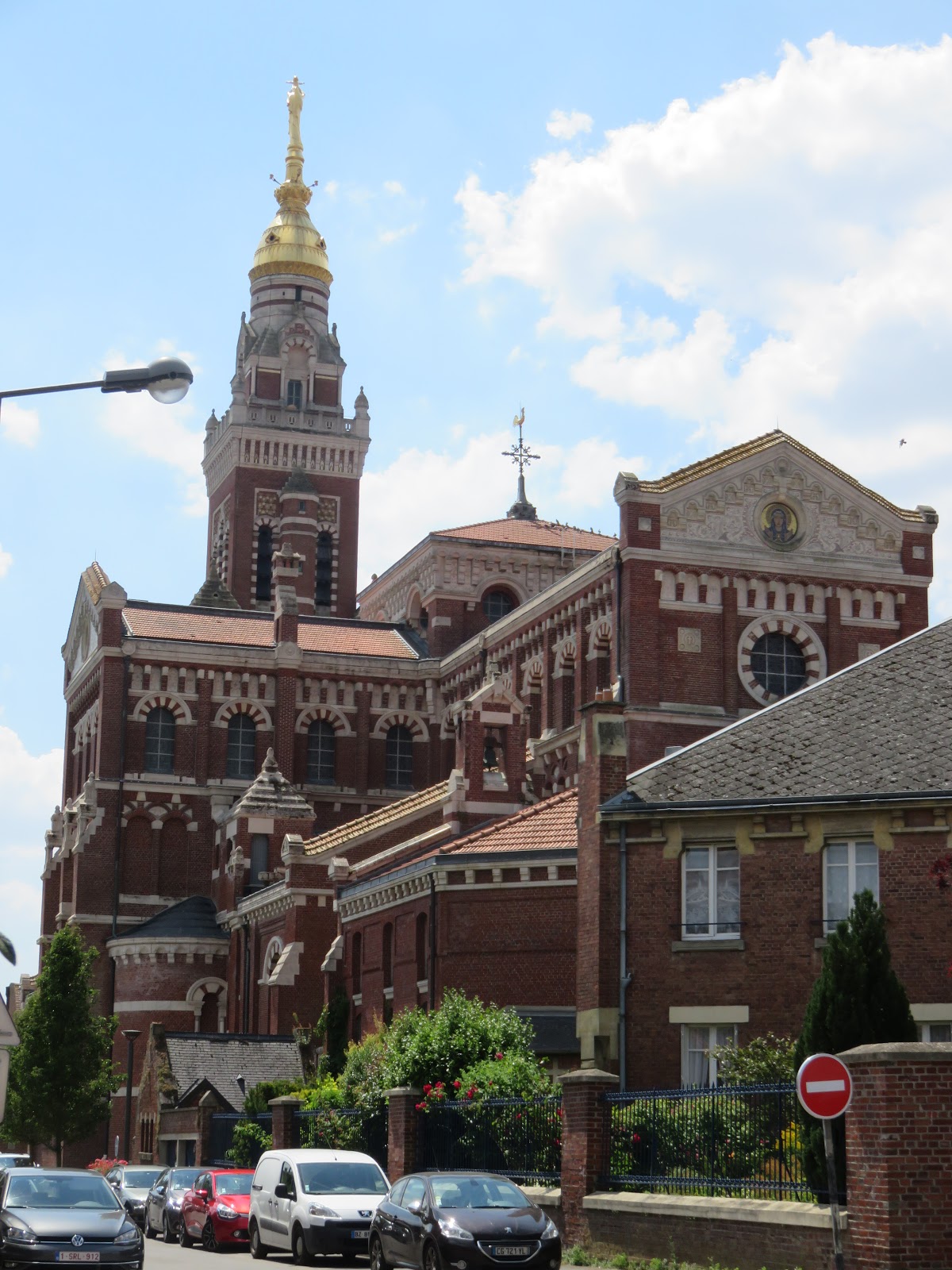
The cathedral in Amiens. It survived the wars.


I was investigating a heap of things for a heap of reasons, but when I began my research a few months ago, I realised that the debris of World War I lies on Somme landscape the way the debris of goldmining lies on the Victorian goldfields. I needed to understand three periods in that region (the Middle Ages, the seventeenth century, and the end of World War II) but before I could interpret them, I had to understand World War I.

My big advantage in the interpretation is that it’s a centennial year: everyone was willing to talk with me and the museums were stuffed with information. There were pictures of before and after, for example, for bombed sites and for major battlefields. I could take all this out and catch a train and visit a once-destroyed town and check out the fields and wander the streets of Amiens and interpret… everything.

I thought you might like to see some of the things I saw. This is not a complete guide. Not even close to one, in fact. This is one small element and even that element is something I’ll be processing what I saw until I’ve finished the novels I’m working on. Maybe longer. It will take far more than a blogpost to explain that landscape.

My focus today, then, is on the effect of World War I on the area of the Somme around Amiens. I went up to two trainstops away in more than one direction to see what I could see.

The first thing that struck me was the missing places. There are some complete landscape changes in the region. Some of it is the usual (villages deserted because the people moved elsewhere) but in the Somme region, there is a very disturbing type of desertion. The satellite map shows places where trains and roads still do not go. This is the worst remaining parts of the Zone Rouge. The Zone Rouge was much larger a hundred years ago, but the web tells me it will take 700 years before every part of the battlefront region from World War I is liveable again.

The Red Zone is that part of the front line that was so destroyed by battle that it needed to be mended before it could be lived in. I visited part of it that had been mended and looked at maps of those parts that I can’t get to.

This is a street in a torn named Albert, which was rebuilt almost from scratch. 

“You can’t live here, it’s dangerous” was the official word. 

“It’s home,” said the locals and rebuilt.


I visited because that rebuild was so important to me for so many reasons. It reminded me that houses are not the only thing in a hometown. Places of beauty and places of awe make a difference, too. Albert has all of these. It was mostly built in the 1920s, but it remembers the earlier past through its landmarks.


Each place in a ruined landscape makes different decisions or has decisions made for them. I talked to a potter in Amiens, and he told me about his family. Their town was never rebuilt. There’s a museum there, he said, but there are no trains or buses. Also no residents. His family moved to Amiens because there was nothing left for them.

Not everything is destroyed on or near a military front line ,even one as destructive as that in World War I. Amiens was partly destroyed, Bits of it are old. Bits of it are new. Bits of it are rebuilt in older styles, in an attempt to not lose its past. Amiens has an important history and a lot of rebuilders commemorated that history by having houses that have an earlier ‘feel’ or that take  stones and carvings from the rubble and make them part of a home. I have hundreds of pictures of Amiens, because its way of balancing survival and rebuilding and moving forward is very much its own. This means that the city’s character emerges in all the sectors of the town, whether they’re the once-a-citadel or whether they’re tourist sections or whether they’re remnants of the nationally important seventeenth century place.


Amiens added to this complex streetscape as part of its commemoration of World War I. It has photographs of the war telling stories using the streetscape. Those pictures show us who fought; they show us the damage: they remind us that scars do not heal easily.


It’s easier to think that war is past if one lives on the other side of the world. It’s harder if one sees a new house where the family home once rested. It’s much harder still if one looks at a plantation of pines that once held the town one’s family had lived in for generations.

Something that tangles the Somme landscape is the sorrowful tourism for families of soldiers.  People from outside the region want to see the destroyed landscape. Only some of them have interest in the region itself. Right now, there are Aussies everywhere, retracing the tracks of their fallen relatives. It’s become a replacement industry for the region, making up for everything that was lost in World War I and then World War II.

This is not new. The extent of the tourism is something that’s only a hundred years old, but the memory of war in what used to be Picardy is not new at all. This landscape is scarred because of where it is and how rich the soil is. Some of the best farmland. Old cultures, cool people. And so it has suffered in war after war after war. The stuff, in fact, of stories. Some of the great French battle epics are set in this part of France. English-speakers think of the English/French interface. Readers of Dumas think of La Rochelle. Everyone thinks of Paris. But this area has a special history and the landscape is much harder to read because of this history. 

What looks like fields and forest may also be layers of buried sorrow.

History in my writing, a reflection - Gillian Polack


It's a very cold winter in Canberra. I ate lemonade fruit tonight and pretended it wasn't cold, but outside right now, it's zero degrees. It's easy to think about ghosts in the dark season and about being haunted.

Some winters are haunted in a good way. A collection of my short stories was released in June and the new edition of my time travel novel will be out in just two weeks. This means I’m haunted by how my writing has changed over four decades. That’s not what I’m going to talk about here. This is because there’s an even more interesting change that has happened to my writing and it’s one that’s a lot more interesting to people in this corner of the internet: how I use history in my fiction has changed.

In my heart of hearts I am an historian. I will always be one. 

When I was a child, I didn’t bring history together with fiction the way I do now. They were two equally important parts of my life, but quite distinct. I built a wall between them in fat, and kept building whenever I noticed one from the vantagepoint of the other. This began to change when I was an undergraduate, because I became an ethnohistorian and historiographer. This means my most important sources for my history werefiction. I used fiction to interpret the period and place a story was written. In fact, for my undergraduate thesis, I used the Old French chanson de geste to get some insight into how people described history in the twelfth and thirteenth centuries. My history back then was challenging and theoretical.

My fiction back then was either straight literary (the story I won a prize for was about how an actor acted) or pure science fictional. Examples of both of these were included in my new collection and they made me wonder “Why wasn’t I writing historical short stories?”


Sherwood Smith, in her introduction to Mountains of the Mind, gave me the answer. My fiction is generally very tight character-based narrative. And it’s much harder for a cultural historian to stay in the head of someone not from their vicinity. The very nature of my research until a few years ago kept me at arm’s length. I knew that I couldn’t think like someone from twelfth century France, so I didn’t write much fiction using the Middle Ages even though I was not only a medieval historian, but one to whom other writers came for help. My specialisation was a two-edged sword.


I mocked myself about it. One of my short stories “Horrible Historians” is me laughing at my incapacity to break past the historian’s responsibility to not get too close to their subject.
Langue[dot]doc 1305was a sea-change for me*. I didn’t just create time travellers going back to my period: I finally sorted out how to get inside someone’s mind without breaking faith with my historian self. I also explored how other writers worked with history, and began to understand so many things about the wall I'd built for myself.

If I had a wall between my history and my fiction and if I was dismantling that wall, this novel was a volcano. It could erupt at any time and destroy a lot of things I loved. It didn’t. There were moments when I was researching and I had to write it in a particular way to deal with what we know about the past and what we cannot know about the past and the fact that a good novel makes the past real to readers regardless of how much we actually know and how little we can know. But those moments didn’t result in any volcanic action.

Ever since it first came out, I’ve been waiting for fellow-historians to say “This is all so very wrong” or for fellow fiction writers to say, “Shame you can’t write a good novel.” Neither has happened. Either they like it (and tell me so) or they’re politely quiet. I haven’t had to breathe in fumes of outrage. There may be a volcano, but if there is, it hasn’t even breathed gas.

This led, as night leads to day, to a change in my research. I wanted to know why we don’t get enough historical novels that have this placid effect on historians. What it is in our culture that helps us (as writers) choose what we put in our fiction? What do we put in our fiction without even thinking about it, by default? That’s what I’m working on now, and it’s illuminating. I’m writing more and more history into my fiction as I learn which choices come from where and what they actually do.

What this means is that I’m still a cultural historian, still an historiographer and still an ethno-historian. I’m partly a specialist in the Middle Ages and partly a specialist in narrative.
It turns out that my fiction and history were always linked. I just didn’t know what the links looked like and now they’ve morphed into something quite visible. Now that I can see them, I’m using a lot more history in my fiction. I finally understand what I’m doing, you see.
What am I doing this month? History in France. It’s time for a research trip so that I can write a new novel that uses history in fiction. I want to push these ideas a bit further.


*It’ll be out again on 17 July. Let me give you the new cover, to rejoice in its re-release.