Showing posts with label Miranda Miller. Show all posts

Crossing the Alps by Miranda Miller


   While researching my current novel, which is set in 18th snd early 19th century Rome, I came across some interesting descriptions of how it was to cross the Alps before there were any railways. Crossing them on a train is still a memorable experience but our tourism is a very feeble experience compared to theirs. Most Grand Tourists had to cross the mountains to reach Italy, and a young man was not considered truly educated and civilised until he had experienced the wonders of Italian art and architecture.

   Crossing the Alps usually took eight days. There were no coach roads through the Alps until the end of the eighteenth century and so, to cross the Alps, your entire coach had to be disassembled and carried over the mountains on mule back. The Mount Cenis pass, on the route from Lyons to Turin, was the most travelled route into Italy during the heyday of the Grand Tour. Tourists were carried over the mountains by Swiss chairmen in a sort of open sedan chair.


     Miss Wilmot, one of the rare women to make the Grand Tour, reported that the Swiss chair carriers were happy men who burst into song as they approached Alpine villages. Some tourists had the thrill of sledding down a steep slope. When you reached Turin your carriage was reassembled. In 1775, “Mr. Greville drove his phaeton up the St. Gotthard, to every one’s amazement.”

   The mountains themselves inspired an awe that, perhaps, only mountaineers can know nowadays.The English journalist Joseph Addison described the Alps as this “awful and tremendous amphitheatre,” while the poet Thomas Gray said that Mt. Cenis carried “the permission mountains have of being frightful rather too far.” One route was the St. Gotthard Pass and its “Valley of Trembling,” which gave the name tremolite to a mineral found in its granite walls.

   Scientists, as well as rich young men, were fascinated by the terrifying mountains. Johann Jacob Scheuchzer, an 18th century Swiss botanist and mineralogist who was a Fellow of the Royal Society of London, made nine journeys in the Alps. As well as recording the elevations of mountains he included several reports of dragon sightings in his Itinera Alpina (1723). Although Scheuchzer dismissed some of these tales as fabulous, he concluded that “from the accounts of Swiss dragons and their comparison with those of other lands...it is clear that such animals really do exist.”

   In the early 19th century the Romantics found mountains endlessly - well, romantic. In Book VI of The Prelude Wordsworth describes crossing the Simplon Pass on foot as a young man of twenty:


Imagination—here the Power so called

Through sad incompetence of human speech,

That awful Power rose from the mind’s abyss

Like an unfathered vapour that enwraps,
At once, some lonely traveller. I was lost;

Halted without an effort to break through;
But to my conscious soul I now can say—
“I recognise thy glory:” in such strength
Of usurpation, when the light of sense
Goes out, but with a flash that has revealed
The invisible world,

   An invisible world, heroism, the sublime.... these ideas, even more than the physical danger and discomfort, caught the imagination of a whole generation. Schiller popularized the legend of a medieval Swiss hero, a freedom fighter of the mountains, in his play William Tell ( 1804).

   In his long poem Manfred Byron’s alter ego gazes in wonder at the Jungfrau and Eiger mountains:
“Heard avalanches falling every five minutes nearly – as if God was pelting the Devil down from Heaven with snow balls... clouds rose from the opposite valley curling up perpendicular precipices – like the foam of the Ocean of Hell during a Springtide.”


   Here is Manfred, looking particularly Byronic, about to be blown off the Jungfrau. Byron’s poem was later set to music by Tchaikovsky. Byron, like many passionate nature lovers, didn’t think much of his fellow human beings: “Switzerland is a curst selfish, swinish country of brutes, placed in the most romantic region of the world. I never could bear the inhabitants, and still less their English visitors,” he wrote to Thomas Moore in 1821.

   Napoleon planned to launch a surprise assault on the Austrian army and in May 1800 he and his army of more than 40,000 men spent five days crossing the St Bernard Pass. Napoleon’s military tactic was successful and resulted in his victory at Marengo.


   Here is David’s great propaganda portrait of a dashing young hero on a white stallion leading his army over the mountains. Napoleon did not actually lead his troops over the Alps at all but followed a couple of days after them, travelling on a narrow path on the back of an unpicturesque mule. Napoleon refused to sit for this portrait : “Nobody knows if the portraits of the great men resemble them, it is enough that their genius lives there.” One of David’s sons stood in for him, dressed up in the uniform Napoleon had worn at Marengo, perched on top of a ladder. Napoleon, acutely aware of the power of symbolism, insisted on an equestrian portrait.

   Like everybody else in Europe, Turner was fascinated by Napoleon. He had not yet been to Italy in 1812 when he painted Snow Storm: Hannibal and his Army Crossing the Alps.


   Another great warrior, Hannibal, is leading his armies over the mountains to attack Italy. For Turner there were obvious connections between the two men,  also between the Punic War between Rome and Carthage and the Napoleonic wars that were then raging between Britain and France. He had seen David’s heroic painting of Napoleon during a visit to Paris in 1802.


   By 1818 Mr. B. Emery, of Charing Cross London, was organizing stagecoach tours of Switzerland. Hikers, mountaineers and honeymoon couples began to cross the Alps and it all became rather less sublime.

Oxford Street by Miranda Miller


   One morning last week I went on a rather doleful shopping trip to Oxford Street. In the clothes departments shop assistants outnumbered customers and full racks of garments pleaded to be liked. As I walked through those designer mausoleums I remembered my childhood, when my shopaholic mother and grandmother took me on all day shopping trips . After an orgy of trying on clothes in bustling department stores these trips ended in the ground floor cafeteria in Selfridges with me, as a fat little girl, standing up to eat an enormous ice cream called a Knickerbocker Glory. Now that some people think that department stores will disappear from all our High Streets, it seems a good idea to remember their interesting pasts.

   Towards the end of the 19th century Oxford Street changed from residential to retail. The first department stores were exciting and innovative. In Zola’s wonderful novel Au Bonheur des Dames (1883), a department store in Paris is the main character: a self contained world, a kind of paradise where women of all ages revel in colour and choice and sensuality. Not exactly a feminist message - but in fact, for middle class women, the arrival of department stores did represent a kind of independence. In mid-Victorian England it was not considered acceptable for a ‘respectable’ woman to go out unchaperoned whereas, a generation later, a shopping trip to a department store, where clothes, furnishings and lunch or tea could all be found under one roof, was allowed. 
This photo shows a horse drawn John Lewis delivery van.

   John Lewis was a buyer of silks for Peter Robinson, which has now disappeared. It was on the site at Oxford Circus where Topshop is now. He bravely set up his own draper’s shop at 132 Oxford Street in 1864. Over the next thirty years he expanded and when a court injunction banned him from extending his shop into Cavendish Square he defiantly spent three weeks in Brixton Jail. He eventually won and the stuffy residents of Cavendish Square had to put up with his enormous shop. His son, Spedan Lewis, was not a conventional businessman. As a young man Spedan had a serious accident when he fell from his horse whilst riding to work through Regents Park. He took two years to recuperate and seems to have thought hard about the unfairness of a world where he and his family took more money from the business than all the rest of their employees together. When Spedan eventually inherited both John Lewis and Peter Jones ( in Sloane Square) he spent decades setting up a trust, or Partnership, which transferred some of the benefits of ownership to his employees.

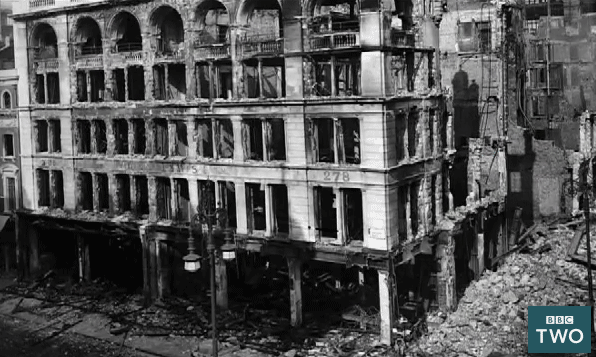
  The original John Lewis shop was destroyed in the blitz and remained a bomb site until it was rebuilt in the late 1950s. The winged figure on the east wall is by Barbara Hepworth. Many other buildings nearby were damaged during the war. In 1941 George Orwell wrote in his diary that Oxford Street was "completely empty of traffic, and only a few pedestrians". He saw "innumerable fragments of broken glass."

   Debenham, next door to John Lewis, started as a small drapery store on Wigmore Street in the 18th century, when Mary-le-bone was a village. The shop later grew and sold drapery, silks, haberdashery, millinery, hosiery, lace and family mourning goods.The latter involved a complex and expensive etiquette; after Prince Albert’s death in 1861 Queen Victoria wore her widow's weeds until she died in 1901. Many people felt obliged to follow her example and after a death entire households were expected to wear black. This sad photo shows a baby with black armbands.


   D H Evans, which my mother and her friends called D H Heavens, once stood where House of Fraser does now. In 1879 Dan Harries Evans, a farmer’s son from Llanelli, bought a small draper’s shop in Oxford Street. His wife did the dressmaking and other members of the family helped out. They specialized in fashionable lace goods and eventually,in the 1930s, their shop became a department store.

   Selfridges has the most colourful history of all these department stores although not, perhaps, quite as lurid as the TV series Mr Selfridge.


   This photo of Selfridges under construction shows how many buildings were demolished in order to build it. Harry Gordon Selfridge was 51, and already very rich, when he opened his new emporium. He began his career a stockman in the warehouse of a Chicago department store and, 25 years later, was a junior partner. His wife, Rose, was a shrewd business woman and property developer.

   On a visit to London he was shocked to see how old fashioned British shops were. His new building managed to be both modern and classical (In 2003 it was awarded a English Heritage plaque). There was a roof garden and new ornate window displays. A clock with an enormous figure called The Queen of Time still reigns over main entrance. Selfridge said his aim was "to make my shop a civic centre, where friends can meet and buying is only a secondary consideration." Could he be held responsible for introducing the consumer society? Some of his catchphrases were: “The customer is always right;” “Only [so many] Shopping Days Until Christmas,” and "I am prepared to sell anything from an airplane to a cigar".

   In fact when the vast store did open, in 1909, the monoplane in which Louis Blériot flew across the Channel for the first time was on public display. Over the four days of the launch event about 150,000 people visited the store and 30 policemen were needed to hold back the crowds. For the first time cosmetics and perfumes were put on display at the front of the store. In other London stores make-up. which many people still disapproved of, was sold in side rooms or even in areas hidden by blinds.

   The huge success of his new store made Selfridge more innovative - and more megalomanic. The 'Earl of Oxford Street' introduced a Bargain Basement to attract poorer customers. After the First World War he wanted to erect a massive tower (very Trumpian!) and a subway link to Bond Street Station, which was to be renamed “Selfridge’s". The book department expanded to become the biggest in the world. In 1925 the inventor John Logie Baird demonstrated the first television in the store and, later, the BBC transmitted live music broadcasts from the roof garden. There was a library, reading and writing rooms, reception rooms for French, German, American and "Colonial" customers, a First Aid Room and a Silence Room, with soft lights, deep chairs, and double glazing. Selfridge even - a most revolutionary idea then - installed toilets for women shoppers

   During the Blitz Selfridge's windows were bricked up for safety. Although the roof was damaged by German bombs the shop continued to trade and the basement was converted into a communications base, with a dedicated line run along Oxford Street to Whitehall so that Churchill could make secure direct telephone calls to Roosevelt.

   After his wife, Rose, died during the flu epidemic in 1918 Selfridge became wildly extravagant. He lost a lot of money gambling and had expensive affairs with (amongst others) the famous Dolly Sisters and Syrie Barnardo Wellcome, who later become Syrie Maugham. He entertained lavishly. both at his house in Mayfair and on his his yacht. In 1941, when he was 83, Selfridge was forced to resign because he was deeply in debt, and the apostrophe was removed from the department store's name.

   So department stores were once great centres of urban life. Chaplin recognised this in his 1916 silent film The Floorwalker, in which the little tramp has fun with escalators and mirrors.


London Nights by Miranda Miller


   A visit to the London Museum always makes me feel much closer to the past. From some of the windows you can see London Wall, Roman walls with medieval additions. The vast excavations for Cross Rail are a great nuisance but they have uncovered unfamiliar corners of the City to be discovered as you walk to the museum, such as Salters’ Garden, the lovely sunken garden in the photo above. It’s laid out with areas of lawn, hedging, pergolas and fountains and the original Roman City wall forms its southern boundary. It belongs to the Worshipful Company of Salters - no, I didn’t know they existed, either, but they’ve been there for six hundred years.

   I was fascinated by London Nights, the exhibition of photographs that is currently at the London Museum. Most of the images are in black and white and made me think of Van Gogh, who considered night “more richly coloured than the day”.


   This exhibition is split into three sections and the first, London Illuminated, is the most impersonal, showing buildings lit up at night. Most of them are familiar but I was intrigued by the one above, showing a brilliantly lit fairy palace on a lake, with the caption White City. I only knew the White City as a rather grim area with a greyhound racing track and TV centre but it had an earlier incarnation: in 1908 forty acres of shining white buildings and waterways were built there for the Franco-British exhibition.


   This photograph shows a bird’s eye view of the site of the Exhibition, which was bigger than the Great Exhibition of 1851 although it is far less well known. With what we would now consider dubious taste, the most popular attractions were the two so-called "colonial villages" - an "Irish village" and a "Senegalese village", which were supposed to communicate the success of the British Empire (just before it started to disintegrate).

   This astonishingly confident event attracted 8 million visitors. The White City Stadium was then hastily built to be used as one of the venues for the 1908 Olympics, which were held in London after Rome dropped out at the last minute due to an eruption of Vesuvius. Another photo shows the long forgotten 1910 Congress Hall, a magnificent illuminated pagoda built for the Japan British Exhibition.

   The second section of the exhibition, Dark Matters, explores the more sinister and mysterious aspects of the night. I particularly liked a short film about a dog called Ella wandering alone on Essex Road at night. She encounters weird animals in the window of a shop called Get Stuffed, runs away from a dog catcher and meets a homeless man who offers to share his bottle with her.
Leicester Square from the series London, c.1909, Alvin Langdon Coburn
   

   This photograph of a gaslit Leicester Square is also hugely evocative. The rather sad area we know now was then the glamorous centre of London’s night life, with oyster rooms and theatres. Here is the Empire, before it became a cinema, and here also were the Alhambra, the Hippodrome and Daly’s. Edwardian sleaze was more stylish than ours and soldiers remembered the pleasures it once offered when they sang, Farewell Leicester Square.

                                          Liverpool Street Station Shelter, 1940 Bill Brandt


   This is one of Bill Brandt’s wonderful photos of Londoners sheltering from the Blitz in the underground which, I think, are as memorable as Henry Moore’s shelter drawings. Brandt was born in Hamburg in 1904, moved to Paris to work with Man Ray and came to England in 1930. He brilliantly documented English social life during the Depression and then recorded the effects of the war in London. He worked for both the Ministry of Information and the National Building Record. Many of his intensely atmospheric photographs were taken at night, without flash, during the city’s blackouts.

   There are also several photographs by Bert Hardy, another outstanding photographer of the period. He was a Londoner who worked his way up from a lab assistant to become a world famous photographer. His warm and compassionate photographs were published in Picture Post, which in its heyday sold nearly two million copies a week.

   The final section of the exhibition, Switch On Switch Off, shows a complex web of associations: work and play and people who work at night, including cleaners and sex workers.
                                                  Piccadilly at Night, Bob Collin

   This photo of young men clubbing in Piccadilly in 1960 seems very remote. Their faces look both callow and sinister, as if they are just as likely to be carrying knives as their grandsons. Suits and ties for a night out have disappeared and so has Swan and Edgar.

   In this last section I enjoyed listening to the rich dark songs of Schubert’s Winterreise on headphones while watching a short film called A Winter Journey. Filmed from the top of a bus at night, it takes us through corners of London that have already become history a few years later, like the Occupy camp in Finsbury Square. This exhibition left me with an exhilarating sense of being in a city that constantly reinvents itself and survives.


The Venetian Secret by Miranda Miller


   In the eighteenth century Italy was the centre of the art world. Young artists flocked to Rome, Venice and Florence and were dazzled by the achievements of past generations. It was widely believed that the great artists of the Renaissance knew a ‘secret’ that had been lost. How did Titian achieve his “divine” colours? Nobody knew but many artists became obsessed with the idea that if they could only discover this secret, which Titian supposedly got from the Greeks, they would outshine their rivals. Paintings by Giorgione and Titian like the one illustrated above, Titian’s Bacchus and Ariadne (1523), had a luminosity and richness of colour that eluded living artists who continued to search for the ‘secret’, rather like medieval alchemists pursuing the formula for gold.

   Joshua Reynolds used to buy up old masters (some of which were probably forgeries) in auctions and literally take them apart to see how they did it. Reynolds hid himself away from his pupils so that they would not discover his manner of working and his many experiments with colours and varnishes. He allegedly bought a painting by Titian in order to strip it slowly, layer by layer and analyse its makeup. But, later, Reynolds’ canvases famously faded and ‘the colours fled.’

   Benjamin West , seen here as a young man, was an American who claimed to have been instructed in the preparation of pigments by native Indians. After his Death of General Wolfe caused a sensation in 1770 he was appointed Historical Painter to King George 111 and later succeeded Reynolds as President of the Royal Academy. Ever since his trip to Venice when he was  young  West had longed to discover the ‘secret’ of Titian’s magnificent paintings. Thirty years later, this made him vulnerable to a hoax.

   Ann Jemima Provis was a young miniaturist whose work was exhibited at theRoyal Academy and her father, Thomas Provis, was a "sweeper of the court" at the Chapel Royal at St. James's Palace. The Provises approached West and told him they had found an ancient Italian manuscript which revealed the Venetian Secret. The original manuscript, they told West, had been destroyed in a fire but fortunately Provis had cannily made a copy. Initially the ‘secret’ was only to be divulged to seven artists and West and six other painters gladly paid 10 guineas each to be initiated. Provis then became even more greedy and suggested that all the artists who were interested in sharing his secret manuscript should form a syndicate of 53 artists. Each member would contribute 10 guineas, which would have earned Provis a total of more than 600 guineas, then a fabulous sum.

   In addition to allowing paid up members of the syndicate to read the manuscript, Ann Jemima offered to give the artists lessons demonstrating the Venetian technique which, she said, included the application of a dark red ground, or foundation layer, to the canvas. She also taught them to use thin linseed oil as a medium to bind the paint’s pigments. It was also essential, she said, to use the “Titian shade,” a mix of ivory black and Prussian blue that was used under glazes of bright colors. Prussian blue was actually invented more than 100 years after Titian’s death. In his own paintings, Titian used lapis lazuli .

   West experimented with these techniques and, with great excitement, used them in his history painting, Cicero Discovering the Tomb of Archimedes , exhibited at the Royal Academy in 1797. Critics were not impressed. The review in The Observer said that “ Instead of possessing Titian’s warmth divine" his new painting had  "nothing but the chalky and cold tints of Fresco, and that gaudy glare and flimsy nothingness of fan painting.’’

   When the scandal about the hoax broke West was the main victim because It was through his influential position as President of the Royal Academy that the Provises were able to meet so many other artists. A popular bawdy song, Paul Sandby’s Song for 1797, hinted that Ann Jemima's secret art lessons also had a sexual dimension. The brilliant satirist James Gillray enjoyed West’s embarrassment in this wonderful engraving:


   Titianus Redivivus; or the Seven Wise Men Consulting the Venetian Oracle – a Scene in the Academic Grove. Seated in a row are some of the artists in the syndicate, including Farington, Westall, Stothard, Smirke, Opie, and Hoppner. Other artists, whose names appear on the far left, had not been taken in by the scam. These include Bartolozzi, Fuseli, and the 22-year-old Turner, whose own later experiments with colour still astonish us. Ann Jemima Provis appears on a rainbow, painting a “portrait” of Titian, her train supported by the Graces. On the far right, in the foreground, Benjamin West sneaks away. The ghost of Sir Joshua Reynolds rises up from the stone floor. In the background, the brand new Somerset House façade of the Royal Academy is cracking, presumably as a result of the scandal.

   There is no record that the Provises were ever prosecuted. Seven years later West painted an almost identical version of Cicero Discovering the Tomb of Archimedes, using more traditional techniques. The colours in this painting have survived and it is now in the collection of the Yale University Art Gallery. West’s career recovered from this embarrassing scandal and he produced many more distinguished paintings. When he died in 1820 he was buried in St Pauls Cathedral.


Mussolini’s Downfall by Miranda Miller


    Last month I spent a few days in a state of near bliss, drifting around Lake Como in boats and swimming in the clean waters, overlooked by the foothills of the alps, pretty ochre, pink and yellow villages, lovely gardens and the villas of billionaires. This lake, which Shelley wrote,  "exceeds anything I ever beheld in beauty, with the exception of the Arbutus Islands in Killarney,” is also the place where the Second World War ended for Italians. As new right wing politicians come to power in Italy it feels urgent to consider this period. Whereas the last months of Hitler are a familiar story, the downfall of Mussolini is not so well known.

   In the evenings I read Iris Origo’s War in Val d’Orcia, a reminder that Italy wasn’t always so peaceful. She kept this diary while she and her husband opened their house in Tuscany to refugees and partisans fighting the fascists. It’s a fascinating book because, like the characters in historical novels - like all of us - she doesn’t know what’s going to happen next. Here are a few extracts from Origo’s remarkable wartime diary:
                                                                    Iris Origo
   

   July 26th 1943. The long-expected news has come at last: Mussolini (who had been in power since 1922) has fallen. The news was given by radio last night but we did not hear it until this morning. Mussolini has resigned, The King has appointed Marshal Badoglio in his place and has himself taken over the command of the Army.

   On July 28th, she writes that in Rome:” A great crowd of working people from all the outlying quarters surged into the city and made its way to the Quirinale (the Presidential Palace), …they broke into all the offices and club rooms of the Fascio, destroyed every bust and statue of Mussolini, set fire to (the offices of newspapers that had supported Mussolini)….Similar demonstrations took place in Milan, Turin, Bologna and Florence.”

   As the news spread down a train that an armistice had been signed, ”flags and carpets were hanging from the windows; at Florence the great bell of the Bargello had been rung; people were weeping for joy and embracing each other. But after half an hour the rumour was contradicted and the excited and disappointed crowd had to be dispersed by the police.”

   By December 23rd:” Of Mussolini no one now speaks and it is said that he himself, on being asked to make a speech on the wireless on October 28th, said: What can a dead man say to a nation of corpses?”

   Mussolini was imprisoned at an hotel in Italy's Gran Sasso massif, high in the Apennines . On 12 September 1943 he was daringly rescued by SS troopers, who landed a dozen gliders on the mountain and overwhelmed Mussolini's captors. The SS leader, Otto Skorzeny, greeted Mussolini with "Duce, the Führer has sent me to set you free.” Mussolini replied, "I knew that my friend would not forsake me!"

                                                           Mussolini leaving the Hotel


   Mussolini was then made leader of the Italian Social Republic  usually known as the Republic of Salò, a German puppet state which lasted for nineteen months. Although he declared that Rome  was its capital, the tiny state was in fact based in Salo,  a small town on Lake Garda where Mussolini and the Ministry of Foreign Affairs had their headquarters. They had nominal sovereignty in Northern and Central Italy but depended on German troops to maintain control. Only Germany and Japan gave them diplomatic recognition and there was no constitution or organised economy - Salo’s finances depended entirely on funding from Berlin.

   On 25 April 1945 Mussolini's fascist republic collapsed.  In Italy this day is known as Liberation Day. A general partisan uprising, together with the efforts of Allied forces, ousted the Germans from Italy.
                                                    Clara Petacchi, known as Claretta.


   Mussolini had left both his wife, Rachele, and his mistress, Clara Petacci, behind in Milan. But Petacci could not live without her Duce and she joined him in Como. She was 33 and Mussolini was 63. As the allies got closer, she and Mussolini went into hiding in nearby Gardone Riviera at the Villa Fiordaliso (now a very expensive Relais & Chateaux hotel). Mussolini, La Petacci and other fleeing fascists were heading for the Swiss border at the northern end of Lake Como. Mussolini was wearing sunglasses and had disguised himself as a German corporal. In the village of Dongo Mussolini’s convoy ran into a roadblock manned by partisans, one of whom recognised Mussolini’s profile from the thousands of propaganda posters that had been plastered on walls all over Italy for the last twenty years.

   On 28 April, two days before Hitler committed suicide in Berlin, the partisans shot Mussolini and Petacci in Giulino di Mezzegra, a tiny village in the mountains above Lake Como. Their corpses were driven to Milan and dumped in Piazzale Loreto. A huge angry crowd gathered to defile their corpses, which were strung upside down from the metal girders of a petrol station, beaten, shot at and hit with hammers.


   This black cross marks the spot where Mussolini and Petacci were killed and in Dongo you can visit the End of WWII Museum. Mussolini was buried in an unmarked grave then, in 1946, his body was dug up and stolen by fascist supporters. Four months later it was recovered and hidden for the next eleven years. In 1957 his remains were allowed to be interred in the Mussolini family crypt in Predappio. His tomb has become a place of pilgrimage and every April the anniversary of his death is marked by neo-fascist rallies.

   Since the war this official version of Mussolini's death has been questioned in Italy, rather like Kennedy’s assassination. Amongst the many conspiracy theories is one about Churchill: that he was desperate to get hold of letters from him that Mussolini was carrying in which Churchill is said to have made all sorts of embarrassing offers to keep Mussolini out of the war.

   I was living in Italy in 1975 when Pasolini, the Marxist film director, poet and intellectual, made a film called Salò, or the 120 Days of Sodom. Set in Fascist Italy in 1944, Pasolini’s film is based on the Marquis de Sade’s novel, 120 Days Of Sodom. I’ve never had the stomach to watch this film, which is still controversial and is banned in several countries (not that there is any point in banning a film in the age of the internet). Pasolini explores political corruption: four wealthy fascist libertines kidnap eighteen teenage boys and girls and subject them to four months of extreme violence, sadism, sexual and mental torture before finally killing them. Before the film was released Pasolini himself was murdered and I vividly remember the sensation this caused.

   It has often been said that Berlusconi (one of several billionaires who now own magnificent villas on Lake Como) has modeled himself on Mussolini - with considerable success. It is impossible to spend much time in Italy without becoming aware that Mussolini is still an important figure. His granddaughter, Alessandra Mussolini, is a member of the Italian Senate. She was elected for a party called The People of Freedom, launched by Berlusconi in 2007, which later became part of  Forza Italia (this can be translated as ‘Let's Go, Italy’). Matteo Salvini, who is now Italy’s Interior Minister, was previously in coalition with Berlusconi. Salvini’s political allies include Steve Bannon, Nigel Farage, Marine Le Pen in France and Victor Orban in Hungary. A few weeks ago Salvini forced the Aquarius, an NGO ship carrying 600 migrants,to divert from Italy to Spain. The President of Italy’s Union of Jewish Communities, Noemi di Segni, said this was reminiscent of Mussolini’s fascist race laws. Salvini has called for a new census of Roma and for all non-Italian Roma to be expelled from the country.