Showing posts with label London. Show all posts

Remembering all the Harrys


Private Harry Reynolds died in France on 29 October 1914, aged 25. A careerist soldier, his service was undistinguished. He appears in the army records only when he lost his equipment and slipped cigarettes to prisoners he was supposed to be guarding.

Harry, who joined up at the age of 14, was 4ft 11, with defective eyes. This short, unremarkable soldier left no family behind. There is no grave for Harry.

I found his story as part of a fantastic community history project in Herne Hill, the leafy corner of South London in which I live. The Herne Hill Society, in partnership with The Charter School and local volunteers, undertook a project to map the men and women connected to Herne Hill who were killed in World War 1. The team believe that as many as 700 local residents were killed. On my street alone, there were five telegrams delivered, five families left bereft.

This is their website and I urge you to explore it: www.memorial.hernehillsociety.org.uk/.


The team has unearthed many heart-breaking stories, including a family which lost its three sons. But somehow, Harry’s story is the one that has lingered. As historical writers, the lives we focus on tend to be the ones that are significant: either because they are remarkable, or they are important, or they fit the narrative pattern we’re seeking to impose.

Harry’s story brings no clarity to the greater picture. It adds nothing but a single digit to an unbelievably large number. The mud of France cracked open, swallowed Harry, and sealed again. 

Most of us will be invisible to posterity and to be troubled by that lack of significance is pompous and hubristic. But most of us will be mourned by someone. Perhaps Harry had friends in the army who missed him. Perhaps poor, short, squinty Harry had a girl at home.

As the veterans of the World Wars die of old age, we need new ways to remember the Harrys. The map that this history project has created is hugely powerful. Children, in particular, need specific stories of flesh and blood people, not numbers, to force them to empathy. My older children were fascinated and appalled by the stories of the fallen soldiers who had lived on our road. The geographic specificity gave them a sense of connection and helped them really think about the lives, and deaths, of these men. 

We talk of bringing history alive, in fiction and non-fiction. To do that demands an emphasis on the commonality of human experience even as we mine the past for instances of difference and uniqueness.

But London, much as I love it, is a strange and hotchpotch place which constantly erodes a sense of commonality. People pass through, neighbours fail to connect. Most of us are incomers to our London villages. Most of us, too, are not church-goers. We don’t have that sense of belonging to a place that can make Remembrance Sunday so unbearably moving: I remember, in particular, being in a village church in Norfolk for one Remembrance Sunday service, and the surnames of the fallen were the names on the graves and, doubtless, in the records of marriages and baptisms.

We Londoners live, secluded in our overpriced houses, and disconnected to our past. We are ancestor-less. 

I was thinking about this, as I watched a friend’s ten year old find the story of a man who grew up in the house next door to her: Lieutenant John Hood. John was born in Herne Hill, and baptised in the church attached to my kids' old school. He studied at Cambridge, and was beginning a career as a teacher, before enlisting. He joined the 29th Siege Battery in France in November 1916 and for the next two years fought in Belgium and France. John Hood survived the German guns, but caught influenza on 11 November 1918, and died three days later in France.


Image result for st paul's church herne hill
An early image of the church where John Hood was baptised.

One hundred years after John Hood caught influenza, the team behind the Memorial project organised a two minute silence in the centre of Herne Hill during the usually busy Sunday market. We stood amid the veg-sellers and the artisan butchers, the smell drifting past from the cheese stall; the fat from the burgers spitting and the steam rising from the giant vat of tartiflette. Kids and dogs and hungover youngsters clutching coffees.  All the busyness of a London Sunday.  Then a teenager from The Charter School played The Last Post, and we all fell still.
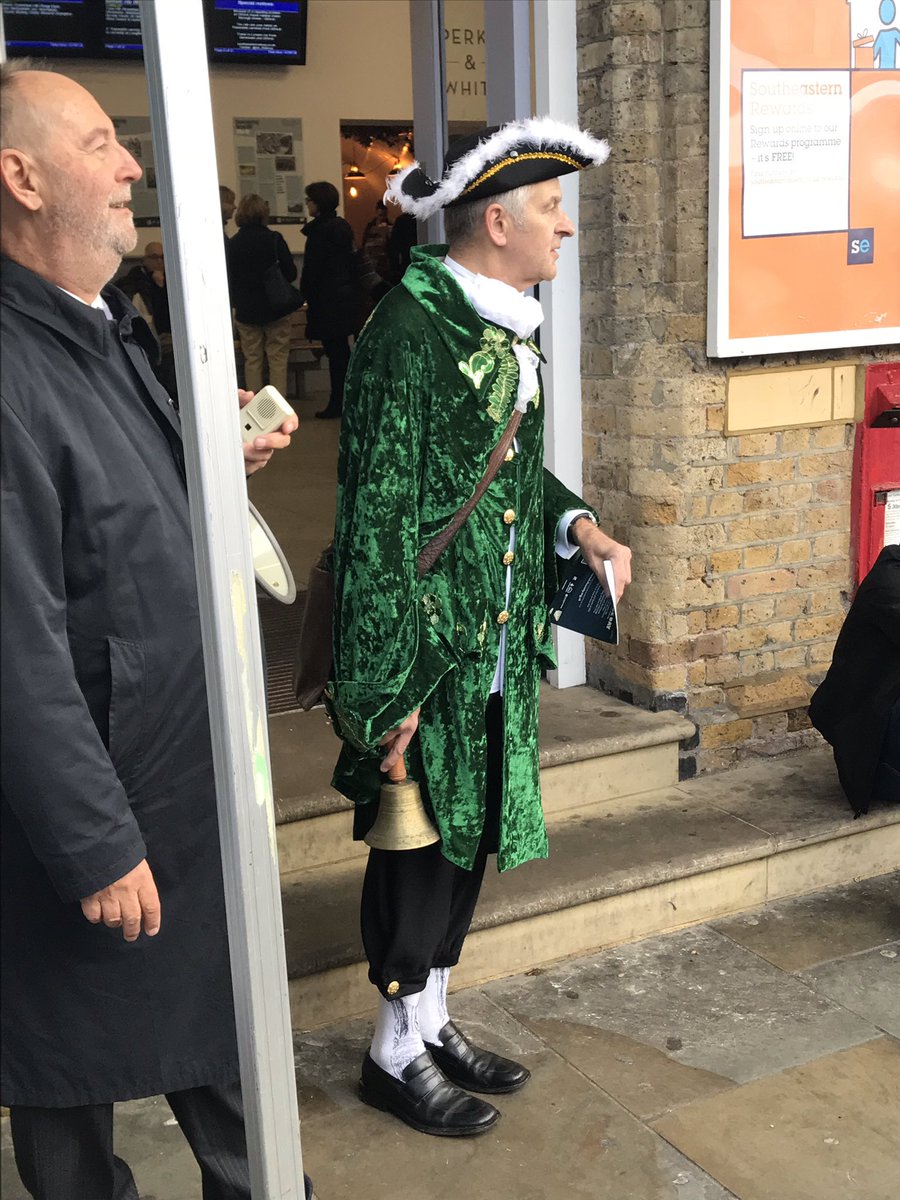
Herne Hill's town crier announcing the silence

There is a particular intensity to a silence that falls on a busy London street. I found it deeply moving - all these decent, unremarkable strangers standing together. It gave me a much needed dose of optimism. I have been dispirited of late by the mood music of public life, and its combative, fearful timbre. We seem to be more frightened than I can remember, more growlingly convinced of the coming apocalypse. Frightened people who feel powerless find anger easy.

We have different visions of the peril: for some it is Trump and Brexit, and the rise of the right; for others Corbyn and a resurgent Marxism. Then there’s the climate. The decline of the US and the rise of a more brutal Chinese hegemony. The coming of artificial intelligence. Putin gurning at Europe’s growing chaos. The likelihood that future generations will, at best, be poorer than us; at worst, face horrors that we cannot imagine. There’s a competitive edge to the catastrophising – my vision is more true and more terrifying than yours. We are strangers, gawping at a pick ‘n mix of dystopian futures.

I keep telling myself that there is an impulse in humans to anticipate an imminent Armageddon. True, yesterday’s silence reminded me that, sometimes, we are right and the Horsemen do sweep in and scythe us down. But it also reminded me that within all the tremulous cacophony of modern British life, there can also exist two minutes of meaningful silence.

@tonisenior 
antoniasenior.com


Sylvia Plath's Letters Volume 2 by Fay Bound Alberti

I have just finished reading the second volume of Sylvia Plath's Letters, published by Faber and Faber. They make for sober reading. The first volume, published in 2017, covered the period 1940-1956. In those, a smiling, bikini-clad Plath beams out from the front cover, while the pages are filled with the optimism and hope of youth. There are pockets of doubt and difficulty, the hint of rape and a suicide attempt, but also Plath's growing certainty of herself as a writer, a woman and an equal to the towering figure of Ted Hughes, with whom she is forever linked.

Letters, volume 1

It is evident from the book jacket that the second volume will be a more serious affair. Gone is the summer sun and the happy expression. Viewed from the side and in monochrome, Plath's expression is serious, her hair tied up in a no-nonsense style. In nearly 600 letters, we follow Plath's marriage to Hughes, their movement around the globe and the UK, her library successes and his more immediate recognition, childbirth and child loss, a breaking-down marriage and her suicide at the age of 30.

Letters, volume 2
To Plath, Hughes was a giant, a genius, a literary God. He must be fed steak for breakfast and waited on, his needs tended to. Yet she also resented her domesticity, her entrapment to the demands of her husband - first moving to Devon because he wanted space, searching for childcare in order to write,  and juggling the demands of that writing along babies, cooking, cleaning and tending to Hughes. The marriage was intense. It was also violent. She wrote to her psychiatrist that Hughes beat her when she was pregnant, causing her to miscarry their second child. 

In the foreword to the book, their daughter Frieda meets these claims head on. She writes in defence of her father, justifying his apparent violence towards Sylvia - which is also recorded in Plath's journals - on the problematic grounds that what was meant by 'a beating' is unclear (a hit, a swipe, a push?) and that her mother had been difficult, needy, disruptive. It is difficult to read this perspective, and to compare it with the plaintiveness of Plath's own journals, the constant fretting about existence that hovers at their margins, her need to do right, live right, be right. 

Yet it is clear in Frieda's foreword how difficult it must be to have parents so utterly in the public eye and simultaneously capable of creating division. Plath was better known after her death than in life, with her books The Bell Jar (a semi-autobiographical novel about a nervous breakdown) and her poetry. Her writing is said to have contributed to the development of the confessional style in literature. And yet it is Hughes who is remembered in Westminster Abbey, not Plath.

The Bell Jar, first published in 1963 
Plath's final letters were written just a few days before she died by suicide in her London flat. She had successfully moved back to the city after being left by Hughes (he was unfaithful with their tenant Assia Wevill, who, in a terrible mirroring would kill herself and her daughter in the same way that Plath died). Plath seemed to be getting better; she had been knocked by Hughes' infidelity and the subsequent rejection of some friends, and she struggled with Frieda missing her father. She was convinced that her daughter had 'latent schizophrenia', and she fretted constantly about her wellbeing. 

It took such effort on the part of Plath to reestablish herself, to find childcare, to push herself back into the London scene, that the exhaustion is apparent on the page. Her letters to people become repetitive as she tells one after another about Hughes' adultery and abandonment, the money he is to pay, his family's turning on her, her living in Yeats' house and how that was fate, and finally, the endless illness, colds and flu of her children. 

In the main, Plath's letters have an enforced jollity even when she is struggling. From time to time she was angry and critical with her mother, but she also felt responsible for her, writing to her sponsor, the American author Olive Higgins Prouty, not to pass on information that might cause Aurelia worry. Prouty had suffered with mental health problems too, so Plath felt she was an ally. Plath was convinced that Hughes wanted her to kill herself, something she refused to contemplate. 

But by the beginning of 1963, despite all her contrived hope and determination, Plath was sleep deprived, unwell, lonely and depressed. On 11 February, having previously convinced herself, and her psychiatrist that she was no longer a suicidal 'type', she left out a snack for the sleeping children, took precautions to seal the kitchen and gassed herself in the oven. 

23 Fitzroy Road, London, last residence of Sylvia Plath

Two years after her death, Plath's collection of poems Ariel was published by Ted Hughes. These poems, including the eponymous poem written on her 30th birthday, drew on the pain of abandonment and loss that had followed her marriage breakdown. This is the writing for which she is best remembered. 


ARIEL

And now I
Foam to wheat, a glitter of seas.
The child's cry 

Melts in the wall. 
And I
Am the arrow, 

The dew that flies 
Suicidal, at one with the drive 
Into the red

Eye, the cauldron of morning. 


The Pleasures and Perils of Living Abroad - by Lesley Downer

My Idealed John Bullesses 
by Yoshio Makino 1912
London in 1900 was like New York today, a city where you craned your neck gazing up at the towering stone buildings while all around people rushed hither and thither, sleek and well-dressed, full of importance. At least that was how it seemed to a sensitive 33 year old Tokyoite called Natsume Soseki who arrived on October 28th that year. 

Tokyo too was prosperous and had its share of stone buildings, built largely by western architects such as Frank Lloyd Wright. But it was primarily a low rise city full of narrow streets of dark wooden houses with bamboo shutters and tiled roofs. London was not just huge - a ‘maze’, Soseki called it - but the heart of the greatest empire in the world, whereas Japan had only just had the insulting ‘unequal treaties’ with Britain and other western powers nullified. When the actress Sadayakko performed here, also in 1900, reviewers expressed amazement that someone ‘primitive’ (i.e. not European, let alone British) should seem perfectly sophisticated.
Fleet Street by James Valentine c 1890

Soseki (his first name and pen name) was a pre-eminent scholar of English literature and one of the first graduates of Tokyo Imperial University’s English Literature department. He had been sent to study for two years by the Japanese government, keen to learn as much as possible from the most powerful country in the world.

But he really didn’t want to go. For a start he had to leave his pregnant wife behind. He had a very small stipend and spent most of it on books, which didn’t leave much for rent. He stayed in a succession of shabby lodging houses - in Gower Street near the British Museum, Priory Road in West Hampstead, the ‘gloomy, squalid neighbourhood of the notorious slum Camberwell’, Tooting and lastly Clapham Common, the one place where he felt even remotely contented. 

Farewell photo before Soseki's departure
for London. Soseki is bottom right
From the start he was lonely and miserable. He hated the weather, the food and the tube, ‘the foulness of the air and the train’s swaying.’ He spent most of his time holed up in his room. The only English people he got to know were his landladies and their families.

When he did go out for a walk, he felt terribly self conscious about his smallness of stature. Everyone he met was ‘depressingly tall,’ he wrote. Once he saw an ‘unusually small person’ approaching and thought, ‘Eureka!’, then realised this person was still 2 inches taller than he was. Finally ‘a strangely complexioned Tom Thumb approaches, but now I realise this is my own image reflected in a mirror.’ In the park ‘herds of women walk around like horned lionesses with nets on their heads.’ He was struck by the fact that even tradesmen ‘are for the most part better dressed than many a high ranking official in Japan ... A butcher’s boy, when Sunday rolls around, will proudly put on his silk hat and frock coat.’

Behind his back he heard people referring to him as a ‘least-poor Chinese’, a very strange adjective, as he noted. He was also mistaken at the theatre for a Portuguese.

To improve his health his landlady suggested that he take up cycling so he set off for the horse riding area on Clapham Common where there would not be too many spectators. His efforts resulted in a series of comic mishaps with him nearly running down a policeman.
Soseki in 1912

Eventually he became so isolated and miserable that his landlady, doctor and fellow lodgers advised him to take a holiday. So he went to Scotland, where he made the discovery that British people didn’t go moon-viewing or appreciate moss and began to doubt whether the British were really worth the reverence in which they were held in Japan.

He did experience some kindnesses. A beefeater at the Tower of London went out of his way to show him a suit of Japanese armour, ‘presented to Charles II from Mongolia.’ He was in London when Queen Victoria died in January 1901 and his landlord lifted him onto his shoulders so that he could see the funeral cortege. 

Nevertheless all in all it was a miserable experience. ‘The two years I spent in London were the most unpleasant years in my life,’ he later wrote. ‘Among English gentlemen I lived in misery, like a poor dog that had strayed among a pack of wolves. I understand the population of London is about five million. Frankly speaking, I felt as if I were a drop of water amid five million drops of oil.’
Plaque at 81 The Chase, Clapham

But in fact Soseki’s lonely years were the making of him. He wrote about them wryly and humorously in several early works and went on to become one of the most beloved Japanese novelists of all time, author of Kokoro, Botchan and I am a Cat, among many others.

Yoshio Makino in contrast adored London. A artist three years younger than Soseki, he arrived a few years before him, in 1897, though there is no evidence that their paths ever crossed.

Makino particularly loved the mist and fog of the English landscape. He wrote, ‘London in mist is far above my own ideal ... the colour and its effects are most wonderful. I think London without mists would be like a bride without a trousseau ... The London mist attracts me so that I do not feel that I could live any other place but London.’

He lived in London for 45 years, mainly in Kensington, and did many paintings - of the Thames, Earl’s Court Station, Sloane Square, all studies in mist; of Fulham Road with a church spire looming out of the gloom, pavements glittering on a rainy night, shadowy nightspots with crowds of women emerging from brightly lit houses into a dark street. 

He also admired British women and painted many pictures of them. He called them John Bullesses (after John Bull). ‘Some John Bullesses bury themselves into such thick fur overcoats in winter. You can hardly see their eyes; all other parts are covered with foxes’ tails, minks’ heads, seals’ back skin, a whole bird, snakeskin, etc. ... But when they get into a house and take off all those heavy wearing, such a light and charming butterfly comes out,’ he wrote.

Soseki’s stay came to an end in January 1903 but Makino stayed on till 1942 when he was reluctantly repatriated. He spent the rest of his life trying to get back to England.


Quotations from The Tower of London, Tales of Victorian London, by Natsume Soseki, translated and introduced by Damian Flanagan, the great enthusiast of and authority on Natsume Soseki. Published by Peter Owen, 2005.

Lesley Downer’s latest novel, The Shogun’s Queen, is an epic tale set in nineteenth century Japan and is out now in paperback.

For more see www.lesleydowner.com

All pictures courtesy of Wikimedia Commons

BOOKS TO MAKE LONDON LIVE FOR YOUNG READERS by Penny Dolan


Last weekend, I was in London, walking beside the Thames in the sunshine and enjoying – despite all the new buildings - the city’s enigmatic sense of the past. History exist as a half-concealed code in so many place names: London Bridge, The Clink, Potter’s Field, Southwark itself, all with their own myths and stories, and there as glimpses along the way: old stonework, an architectural flourish, a memorial, all reminding me that all the old maps of London lie beneath the modern sprawl.

London and the Thames are often there within my writing. especially within the work-in-progress that I’m picking up after a long break. It was the city of my childhood, of my early self’s wanderings, and won’t easily release its hold in my imagination. The weekend, for many reasons was inspiring, and I have come back ready to revisit my fictional London and those grey, ever-moving river tides.

However, for me, writing needs good sleep and good words, so I have begun on some comfort re-reading. Last night I finished Joan Aiken’s The Wolves of Willoughby Chase. and this morning, in bed, I started Black Hearts in Battersea, the second adventure in her trilogy set in the fictitious reign of James III.

“On a fine warm evening in late summer, over a hundred years ago, a boy might have been seen leading a donkey across Southwark Bridge in the City of London . . .  Halfway across the bridge, the boy paused, took and extra turn of the donkey’s halter round his wrist, and pulled out of his pouch a grubby and much handled letter. . . “
The letter, from his friend & artist Dr Gabriel Field, tells fifteen year-old Simon to come to Rose Alley, Southwark, where he has taken two rooms for them at the top floor of a house, which belongs to Mr and Mrs Twite and their brood:
“They are an unattractive family but I see little enough of them. Moreover, the windows command a handsome view of the river and St Paul’s. “
When Simon eventually discovers the house, there is nobody at home, other than: 
 “A shrewish looking little creature of perhaps eight or nine, with sharp eyes of a washed-out blue and no eyebrows or eyelashes to speak of. Her straw coloured hair was stringy and sticky with jam and she wore a dirty satin dress two sizes too small for her.”
This, friends, is Dido Twite, Aiken’s bold young heroine, created well before feisty was an essential publishing term. All Dido wants is a ride on the donkey. Simon, however, is far more concerned by the fact that the two rooms are empty and Dr Field- and all his belongings and artist materials – have totally disappeared, and so the quest begins. Set in an early, alternative nineteenth century, Black Hearts in Battersea presents an alternative historical world where two factions are still at odds over who is ruling Britain - it is fiction – and trouble is afoot in deepest London.

With Aiken’s work at my bedside, I thought about other historical fiction for children and young people set in London. Then, like Simon, I asked around and here, therefore, is a list of favourite London titles, many almost historical in themselves, that might interest you. Some are perfectly fine for nine year olds, while others offer stronger content, harsher settings and bigger reading experiences. You might, like Simon, check things out first – or is that a well-worn rule about London?
 
Coram Boy by Jamila Gavin, inspired by Thomas Coram's Foundling Museum as well as the links between Britain and the riches of India.

Ruby in the Smoke by Philip Pullman: the first in his exciting Sally Lockhart series, as shown on television.
 
I, Coriander by Sally Gardner: historical reality overlaid by the magic of the fairy world and beautifully written.

The Raven Master's Boy by Mary Hoffman – a strong Tudor novel for teens while younger readers might enjoy Raven Boy by Pippa Goodhart. Same birds, different books.

 Slightly Jones and the Case of the London Dragon by Joan Lennon:
A lively girl detective discovers a fossil problem just as Queen Victoria is due to visit the Natural History Museum.

The Diamond of Drury Lane by Julia Golding, set in the world of the London theatre and music halls.

Nest of Vipers, set close by Newgate prison by Catherine Johnson, and Freedom, her novel about slavery.

The Shadow Web by Nicky Matthews Browne: definitely alt-history, where two identical girls somehow swap not-identical parallel lives.

The Mourning Emporium by Michelle Lovric, which begins in Bankside in 1902. A supernatural Venetian villain arrives in London to wreak havoc on a country mourning the loss of its Queen, and on the watery city that declared him a traitor.

The Armourer's House and The Witch’s Brat by Rosemary Sutcliffe, both still in print. Unfortunately, “Ring Out Bow Bells” and “The Load of Unicorn” by Cynthia Harnett  only exist as rare second-hand copies.

The Historical House books, written by Adele Geras, Linda Newbery and Ann Turnbull, re-issued as the “6 Chelsea Walk” series: Girls with a Vote – Polly’s Walk; Girls with a Voice - Mary Anne and Miss Mozart and Girls Behind the Camera: Cecily’s Portrait.All three titles are set at a different time within the same house.

Wartime London appears at the start of several evacuee books, including Michelle Magorian’s Good Night Mr Tom; Letters from the Lighthouse by Emma Carrol and Jimmy’s War by Lynne Benton for slightly younger readers.

There is also River Of Inkby Helen Dennis: the first of a new, time-travelling thriller series for middle-grade readers.

I have just heard about a time-slip novel that features the iconic Alexandra Palace:
The Pearl in the Atticby Karen McCombie. It must go on my list because where else did one go on a North London Sunday afternoon?

And, finally, two true London favourites of mine:

Smith: The Story of A Pickpocket by Leon Garfield, for the wonderful intensity of his characters, his sense of place and ear for language and dialogue.
And
Oliver Twist by Charles Dickens drawn from his own childhood memories of the London streets.

Have you any London-based historical novels for young readers or teens that you’d recommend? (Or any that, like Livi Michael’s The Whispering Road, celebrate another particular city and if so which?)

Penny Dolan

Author of A BOY CALLED M.O.U.S.E (Bloomsbury)

The Gentle Author's East End Vernacular by Imogen Robertson

I'm sure that most if not all of the History Girls and our readers know of the brilliant blog http://spitalfieldslife.com/  If you're not a regular visitor, then do go and spend some time there and you'll discover lovingly written and richly illustrated stories of life in London, particularly the East End. There's a grim but fascinating post on The Hackney Whipping Post, once thought a suitable subject for postcards, now rotting away in a backlot, as just one example from May.

While you're there, I'd also recommend you buy this book, edited by the writer of the blog, The Gentle Author:

Buy Now


I got my copy from the marvellously eccentric bag and packaging emporium Gardeners on Commercial Street, but you can buy copies direct from the blog. Anyone with an interest in art or the East End should get one immediately. And another for a friend.

It's a very handsome, beautifully produced volume which chronicles the artists who have caught the East End on canvas over the last hundred years or so and is a rich sampling of a huge range of work. The Gentle Author takes pains to gather the testimony of the artists themselves which makes for a fascinating, intimate read and an inspiring glimpse into their lives. The images are reproduced with enormous care and if they share anything other than geography it's a sort of intimacy and particularity which makes them, I think, universal in their appeal.


Taken as a whole the book offers a fascinating way to look at the range of styles of art created in paint and pencil in the 20th century as well as a portrait of a shifting urban landscape. I found something particularly fascinating about some of the later images such as those of James MacKinnon and Marc Gooderham who incorporate the street art of the area into their work in the same way earlier artist such as James Boswell used signage and advertising. 

James Mackinnon - Broadway Market (featuring the street art of Eine)
via Spitalfields Life

The book celebrates the work of a healthy number of women artists too, such as Rose Henriques, Grace Oscroft and Pearl Binder and reflects on the particular challenges they faced in their work with clear-eyed empathy.

Grace Oscroft - Bryant and May, Bow. via Spitalfields Life
But please, don't just read the extracts linked to above - get the book. It's delicious and inspiring brainfood and that's always worth paying for.

www.imogenrobertson.com